Recent Acquisitions
April 7th, 2026
To order call toll-free at (800) 441-0076 or 651-290-0700
or email rulon@rulon.com
or, click on the "add to cart" link to order through our website. Phone calls and emails are generally quicker.
All books are guaranteed genuine as described, and are returnable for any reason during the first week after receipt. If you are returning an item, please let us know so we can make it available to another customer.
Shipping and handling charges are extra and billed at cost.

A note on OCLC
As is now the norm, OCLC counts are tentative, at best, as we recognize that searches using different qualifiers will often turn up different results. Searches are now further complicated by the vast numbers of digital, microfilm, and even print-on-demand copies, which have polluted the database considerably, making it difficult, without numerous phone calls or emails, to determine the actual number of tangible copies. Hence, even though the counts herein have been recently checked, most all should be taken as a measure of approximation.



1. The Tantraloka of Abhinavagupta with the commentary of Jayaratha. Edited by Dr. R. C. Dwivedi and Dr. Navjivan Rastogi. Delhi, Varanasi, Patna, Madras: Motilal Banarsidass, [1987].
$300
"Enlarged edition, with introduction," 8 volumes, 12mo, text and added title page in Sanskrit, prefatory matter and introduction (the whole of volume I) in English; a fine and complete set in original red cloth and dust jackets.
First published 1918-38 without the foreword, book-length introduction, four appendices, or the exhaustive tables of contents. "The Tantraloka — the magnum opus of Abhinavagupta, the tenth-century stalwart and an Indian genius of all time from Kashmir — is both an inspiration and a challenge for students of tantric lore. No study on tantra should be deemed adequate unless it takes this celebrated text into account. Written on highly scientific principles, it offers a highly up-to-date (of course, up to the time of Abhinavagupta), encyclopedic, and truly systematic analysis of tantric material and, in the process, stands out as a model for modern research in Indology, an area which, though of vital importance, remains relatively unexplored. It also constitutes the single most important source of authentic tantric information and material, encompassing the divergent fields of philosophy, sadhana, yoga, literature, liturgy, ritual, and historiography" (publisher's blurb).

2. Afghanistan: map of roads. [Kabul?]: printed at the Government Printing House, n.d., [ca. 1960].
$125
Folding lithograph map approx. 13½" x 16½" with main roads shown in red, hotels, gas stations, air fields, and international airports. Very good.
Two in OCLC: Wisconsin-Milwaukee, and the BL.


3. The cultural heritage of India. Calcutta: The Ramakrishna Mission, Institute of Culture, 1970-1991.
$250
Mixed editions, 5 volumes, 4to, 17 plates, 4 maps and plans; dust jackets; generally, a very good, sound, and clean set.
Volume I: The early phases. Introduction by Dr. Sarvepalli Radhakrishnan. Volume II: Itihāsas, Purāṇas, Dharma and other śāstras. Introduction by Chetpat Pattabhirama Ramaswami Aiyar. Volume III: The philosophies. Edited by Haridas Bhattacharyya. Volume IV: The religions. Edited by Haridasa Bhattacaryya. Introduction by Sarvepalli Radhakrishnan. Volume V: Languages and literatures. Edited by Suniti Kumar Chatterji. Introduction by K. M. Munshi. This set lacking the last volume, Science and Technology.


4. Albums humouristiques de la vie Japonaise. N[ouve]lle, series Album II [cover title]. La journée d'une guesha [= 芸者の一日]. [Yokohama and Kobe: [1897].
$1,800
Only edition, small 4to, [29] leaves, consisting of a title page, a final leaf of advertisements for Bigot's series of illustrated books (printed in red and black), and 27 full-page satirical drawings by Bigot; original pictorial wrappers bound in the Oriental manner; covers lightly soiled and spotted, the front cover illustration with bleed-through to the front free endpaper else a very good copy contained in a blue cloth folding chitsu case.
Georges Ferdinand Bigot (1860-1927) was a French cartoonist, illustrator and artist. Although almost unknown in his native country, he is famous in Japan for his satirical cartoons, which depict life in Meiji period Japan ... In 1887, Bigot published a satirical newspaper, Tobae, in which he illustrated mostly scenes of everyday Japanese life, but also ridiculed Japanese politicians and what he felt to be excesses of in the Westernization of Japan. The newspaper had to be published in Yokohama for fear of Japanese censors (see Wikipedia).
Rare. Not found in OCLC or CiNii.


5. Chinese Wilson: a life of Ernest H. Wilson 1876-1930 ... Foreword by Roy Lancaster. London: HMSO, [1993].
$50
First edition, 8vo, pp. xiii, [1], 154; illustrated throughout, including 21 color illustrations at the back on plates; fine copy in a fine dust jacket.
Ernest Henry Wilson (1876-1930) "was a notable British plant collector and explorer who introduced a large range of about 2,000 Asian plant species to the West; some sixty bear his name" (Wikipedia). He later became keeper of the Arnold Arboretum at Harvard University. He and his wife died in an automobile accident in 1930.
"Here his great-nephew [Briggs] uses Wilson's original journals and photographs and previously unpublished family correspondence to delve behind the glamour of his adventures to the personal challenges and hardships he experienced. Complementing the story of his life is a brief account of his living legacy - the plants and trees for which he gave so much and which proved him to be one of the greatest plant hunters of all" (publisher's blurb).


6. The flower ornament scripture. A translation of the avatamsaka sutra. Boston & London: Shambhala, 1984-7.
$200
First edition, 3 volumes, 8vo, pp. 703; 448; 404; full red cloth, gilt title on spine; fine in fine pictorial dust jackets.
The complete translation in three volumes of the Avatamsaka Sutra, one of the most influential Mahayana Sutras. "Venerated by Buddhists of all the universalist schools, this sutra is a treasure of sensual imagery. Through its structure, its symbolism, as well as through concisely stated principles, it conveys a vast range of teachings."


7. Petri Criniti Viri docti. De honesta disciplina. Lib. XXV. De poetis Latinis. Lib. V. Et poematum. Libri II. Cu[m] indicib[u]s seu capitibus singulorum operu[m]. Cu[m]q[u]e tabellis alphabeticis rerum, dictorumq[ue] insigniu[m] ... ab Ascensio collectis & appositis. [Paris]: Venūdantur ab eo-dē Ascensio. [Colophon: Rursus ex aedibus Ascensianis ad cidus Feb. Anno MDXX, i.e. 1520].
$1,500
Folio in 8s, [8], cix, [1] leaves; collating a8, a-n8, o6; woodcut architectural border on title page with printer's woodcut device central; a plethora of decorative woodcut initials throughout, many rather large; ink splash on a8 and b1, manicle on d7v; a fresh, crisp, and clean copy in 20th-century full brown paneled calf, blindstamped lozenge central on both covers, unadorned spine in 6 compartments; a fine copy.
Fourth Ascensius edition (of five) of the three major works of the Florentine poet and biographer Pietro Crinito. The first edition of "De honesta disciplina" was published in 1504, and "De Poetis Latinis" in 1505 by Giunta in Florence.
Pietro Crinito (1474-1507) "was a Florentine humanist scholar and poet who was a disciple of Poliziano. He is best known for his 1504 commonplace book, De honesta disciplina. This has been taken to be a source for the work of Nostradamus. He published in 1504 the Commentarii de honesta disciplina, a mammoth essay of erudition in 25 books that, along the lines of Aulus Gellius, dealt with Linguistics, Politics, Jurisprudence, and religious institutions. Despite some brilliant insights, however, the work is confusing and at times obscure, and the author often falls into the ridiculous or fabulous ... The following year De Poetis Latinis in five books came out, which set out in 93 short chapters to encyclopedically catalogue Latin writers from Livius Andronicus to Sidonius Apollinaris, which, while full of inaccuracies, is by far the first modern biography compilation of classical authors" (Wikipedia).
Adams C-2950 (noting the 1508 Ascencius edition, and 7 later editions, the last in 1598). Ebert 5458; Graesse II, 301. 17 copies of this 1520 edition located worldwide in OCLC, only Stanford in the US.


8. The Pamirs and the source of the Oxus ... Revised, and reprinted from 'The Geographical Journal' for July, August, and September, 1896 . London: Royal Geographical Society; Edward Stanford, 1896.
$275
First edition, 8vo, pp. [2], 83, [1]; 15 illustrations from photographs (1 full-page), table, and a large folding color map; publisher's quarter tan calf gilt-stamped on upper cover and spine; some soiling and overall wear; the map with several short breaks at the folds; a good, clean and sound copy.
Curzon (1859-1925) was by turns a member of Parliament, Under-Secretary of State and Viceroy of India, restorer of the Taj Mahal, Chancellor of Oxford University, Secretary of State for Foreign Affairs, explorer and author, His fame rests today largely on this "daring foray into Afghanistan and the Pamirs" in 1894-95, and for his exploration of the source of the Amu Darya (Oxus) for which he was awarded the Patron's Medal of the Royal Geographical Society.

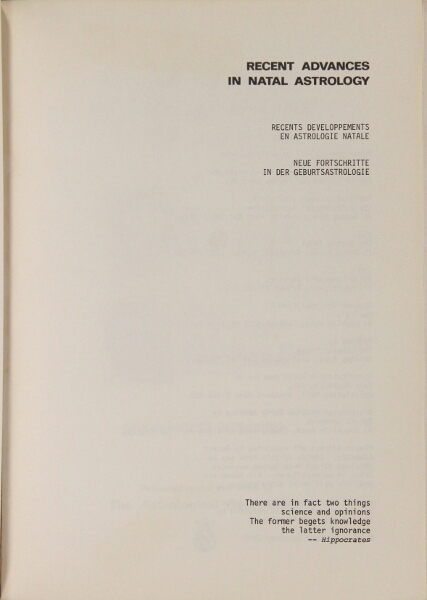

9. Recent advances in natal astrology: a critical review 1900-1976. London: prepared under the aegis of The Astrological Association, 1977.
$150
First edition, 8vo, pp. [8], 597, [1]; printed from typescript; graphs and tables in the text plus thumbnail portraits of the two compilers and 8 collaborators; small scar on spine, else a very good, sound, and clean copy in original printed black and white linen-textured wrappers.
"This book systematically surveys the world's major astrological literature published since 1900. It coordinates and summarizes material from 310 astrology books (out of over 1,000 consulted), 410 journal articles, and 300 relevant scientific works. It took nearly seven man-years to prepare and involved 50 astrologers and scientists from 10 countries" (page 1).


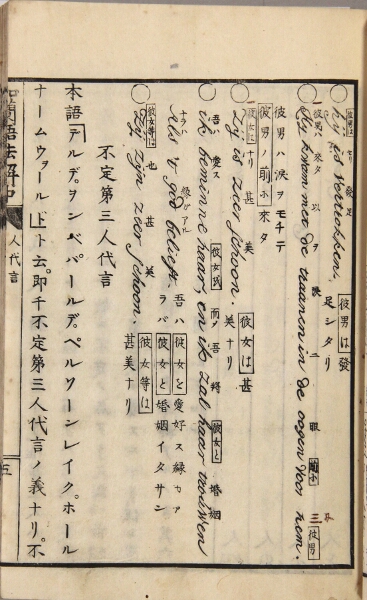
10. 和蘭語法解 / Oranda gohōkai [= Dutch grammar]. Osaka, Tokyo, Kyoto: Yougawadou, 1815.
$2,500
First edition, 3 volumes in 1, fukurotoji, 9" x 6¼", ff. 3, 5, 3, 37; 62; 36, [1]; woodblock printed text; original yellow paper covers, Kaisei and publisher's stamp on title sheet, paper label on upper cover; manuscript table of contents on upper cover, and with a number of contemporary annotations throughout in Japanese and Dutch, two slips of notes inserted; worn; some light foxing and worming, particularly in the third volume; good.
This is the earliest issue of the book which includes the Dutch preface. The second issue omits the preface. Editions recorded as having been printed in 1812 (the date given in the preface) are ghosts. Fujibayashi Fuzan (1781-1836) was a physician and student of one of the fathers of Dutch studies, Ema Ransai. He translated a number of Dutch medical texts, and produced a concise edition of Harumawage, the first Dutch-Japanese dictionary.
In 1810 he produced a guide to Dutch translation, and then in 1815 this Oradago houkai, the first Dutch grammar written by a Japanese, and the first grammar in a western language by a Japanese. Oradago houkai references material from V. J. Peyton, Pieter Marin, and W. Sewel, but is not a slavish transcription but an original synthesis of the available Dutch material.
Osaka Joshi Daigaiku Library, Selected Catalogue on Dutch and English Studies A17 (their copy missing the second volume). OCLC records 4 copies in all: the UC-San Francisco, Indiana, and Leiden copies (all misdated 1812); and a correctly dated (1815) copy at the International Center for Japan Studies in Kyoto.

11. Entretiens du maître dhyâna Chen-houei du Ho-tsö (668-760). Hanoi: Ecole française d'Extrême-Orient, 1949.
$75
10½" x 7½", pp. [6], x, 126, [2]; text toned, top and bottom of spine chipped (no loss of lettering), small puncture mark in upper wrapper, else very good and sound in original tan printed wrappers. Issued as no. 31 in the publisher's Ecole française d'Extrême-Orient Publications series. Early ownership signature on upper wrapper.
"Traduction annotée de quatre manuscrits de Touen-houang publiés en 1930 par M. Hou Che" (introduction). "Chen-houei of the Ho-tso (also commonly transliterated as Heze Shenhui (ca. 668–760) was a highly influential Chinese Buddhist Chan (Zen) master during the Tang Dynasty. He is best known as a disciple of the Sixth Patriarch, Hui-neng, and as the monk who founded the Heze school of Chan" (buddhism.lib.ntu.edu.tw/).


12. Viaggio di F. Giovanni da Pian del Carpine ai Tartari nel 1245-47 (Historia Mongalorum) a cura di Giorgio Pullè, con introduzione, note e incisioni. [Milano]: Istituto Editoriale Italiano, [1956].
$135
First edition, 8vo, pp. [10], 13-217, [5]; title page printed in blue and black, 4 folding maps, 11 plates from contemporary sources; text lightly toned, else a near fine, bright copy in the original dust jacket.
"Giovanni da Pian del Carpine OFM (ca. 1185-1252) was a medieval Italian diplomat, Catholic archbishop, explorer and one of the first Europeans to enter the court of the Great Khan of the Mongol Empire. He was the author of the earliest important Western account of Northern and Central Asia, Eastern Europe, and other regions of the Mongol dominion" (Wikipedia).

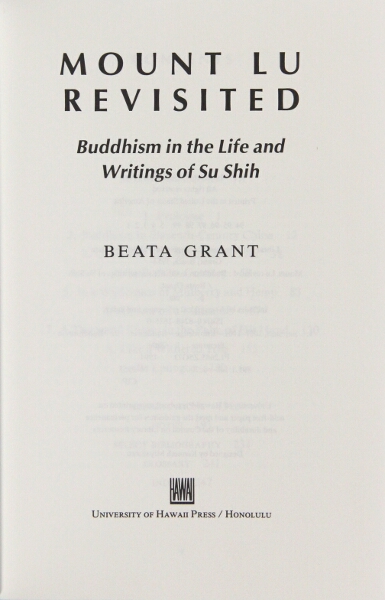
13. Mount Lu revisited: Buddhism in the life and writings of Su Shih. Honolulu: University of Hawaii Press, [1994].
$75
First edition, 8vo, pp.vii, [1], 249, [3]; fine copy in a fine dust jacket.
"Su Shih (1037-1101) is regarded as one of the greatest Chinese literary and intellectual figures not only of the Northern Sung but of all time. He has been the subject of many studies but, until now, none have attempted to address fully the vital question of Buddhism in his work. Beata Grant has uncovered among Su Shih's voluminous writings an extraordinarily wide range of Buddhist-related poems, hymns, essays, and other writings that attest to Buddhism's importance in the literary culture of this period" (publisher's blurb).


14. The GI guide of Japan. [Tokyo]: Francis T. Justice & Co., publishers. [Printed in Japan by Radiopress], 1954.
$150
First edition, 8vo, pp. [6], 178; illustrated throughout with about 2 dozen advertisements (some full-page); without the 5 leaves of perforated coupons bound in at the front, all apparently used but probably not by Robert & Mary Wood, with an inscription on the first leaf to them by Bardwell and Charlotte, as "a reminder of Japan shortly after your tour ... this book published in 1954 will take you back..."; all else very good, sound, and clean in original pictorial limp yellow cloth stamped in red and green.
Designed for servicemen from the Army, Air Force, and Navy; also for tourists, residents, and traders. Included are sections on the restaurants, cabarets, dancehalls, nightclubs & bars; shops & department stores; theatres and sports arenas, sightseeing tours, banking services, government offices, embassies, religious organizations, postal information, shipping, phones & telegraph, etc., and including similar information for Yokohama, Nagoya, Osaka, Kyoto, and Kobe.
Not found in OCLC.


15. 山のもの山のもの / Yamanomono Yamanomono. Tokyo: Hakuousha, n.d. [ca. 1946].
$375
8¼" x 7¼", pp. [1], 17, [2]; two-tone illustrations throughout; pictorial paper wrappers; light soiling to wrappers, occasional slight creasing to a few leaves, some internal toning, but generally very good and sound.
Hatsuyama was a printer of sosaku hanga (i.e., "creative prints"— an art movement of woodblock printing which was conceived in early 20th-century Japan), and an illustrator of children's books. He was a prolific contributor to children's magazines and art journals, but stopped all production of art for children leading up to and during the Second World War in protest of militarized themes that had taken hold of the industry. This book, which tells the story of a group of mountain animals who gather up food to give a starving town, was published shortly after the end of the war, during a time when Japan was suffering from severe shortages and such starvation was a reality for many of the country's children.
National Diet Library only in OCLC. Museum of Modern Japanese Literature only in Ci.Nii.


16. [Japanese Maritime Manuscript.] Multi-volume maritime manuscript emanating from the Nojima Murakami clan. [Japan: ca. 1820].
$6,500
15 volumes, fukurotoji; containing approximately 190 illustrations, charts, diagrams, graphs, etc., accomplished in watercolor and ink; contemporary paper wrappers, manuscript title labels (2 perished, 3 others slightly defective); occasional worming throughout (particularly noticeable on the final volume); ownership stamps on upper covers of Hachirō Yamagami (the Japanese historian of Japanese armor and weaponry), Hara-shi Bunko (library) stamps on some internal pages, some dampstaining in a few volumes, one volume nibbled at spine, 1920 purchase ticket on lower pastedown of one volume; faults aside, a very good, clean set.
A collection of naval and nautical texts derived from the Nojima Murakami clan, an important naval power in the Seto Inland Sea during the 17th century. Working variously as regional officials and pirates, they maintained control over a significant passage southeast of Hiroshima. The text covers a comprehensive survey of naval management, including the building and equipping of ships, naval formations, tactics and strategy, the building of docks, seawalls, and jetties, weapons, firearms and traps, drum signals, organizational structures, Nojima naval history, etc. This collection of manuscripts consists of the following titles:
能島流制作之巻 (on the construction of ships, weapons, armor), 3 volumes, plus appendix volume; ff. 19, 23, 24, 25;
能島流船江制作之巻 (on waterworks and docks); ff. 20;
能島流船術之巻 (on naval tactics), 2 volumes; ff. 19, 13;
能島流船規之巻 (regulations); ff. 16;
能島流兵制之巻 (logistics and statistics), ff. 11;
能島流軍儀(議)之巻 (military organization, etiquette and tactics); ff. 19;
能島流備立之巻 (on naval preparation and formation); ff. 24;
能島流水戦之巻 (on naval warfare), 2 volumes; ff. 17, 20;
能島流火戦之巻 (on firearms); ff. 10;
能島流中之伝奥意陰巻利弁問答 (transmission of strategic secrets, this volume in a different hand); ff. 4.
Manuscript copies of this text do not appear to be at all common and often exist in fragments only. A copy of 能島流水戦之巻 is recorded at the University of Tokyo for example. We could find no record of a printed edition of the text.


17. Commodore Perry's expedition to Hakodate, May 1854. A private account with illustrations. [Forewords by Alice Cheney and Dora A. Wagner. Preface by Yoichiro Saito]. Hakodate: Hakodate Kyodo Bunkakai, [1953].
$125
Limited edition, printed in an unknown quantity (likely 1,000 - this being no. 369); 2 volumes, 8vo, fukurotoji; pp. 30, [4], 60; (pages 15-16 never bound in but here neatly supplied); 172; text in Japanese and English, 2 maps (1 folding, 1 double-page), illustrations after those in the original manuscript (some in color); purple paper covers, printed paper label on upper covers; very good copy, contained in the publisher's chitsu case with original paper label on upper cover.
Volume 1 is a facsimile reproduction of a private manuscript journal (with interesting contemporary illustrations), in the possession of the Hakodate Public Library (Shiritsu Hakodate Toshokan). Volume II contains the printed text of the work as well as an English translation by Alice Cheney.


18. Armenia: travels and studies. London, New York, Bombay: Longmans, Green and Co., 1901.
$1,250
First edition, 2 volumes, large 8vo, pp. xv, [1], 470; xi, [1], 512; complete with folding color panorama bound in as frontispiece in volume I, color frontispiece in volume II, large color folding map in pocket at back of volume I, 96 maps and illustrations on plates (some folding, some in color), and another 97 illustrations in the text; publisher's quarter blue buckram over tan cloth, gilt-stamped spines, t.e.g.; boards with some spotting and darkening, but the spines bright and clean; overall, a very good, clean, and sound set. Armorial bookplate of William Basil Worsfold in each volume. Wolsford (1858-1939) was a British writer who wrote and published many books during the late 19th and early 20th centuries on British colonial history, particularly South Africa, and in 1904 became chief editor of the Johannesburg Star newspaper.
Volume I deals with the Russian provinces, and the second volume the Turkish provinces. This remains one of the best books on Armenia, lavishly illustrated, and detailed in its analysis of its peoples, geography, politics, and statistical information.

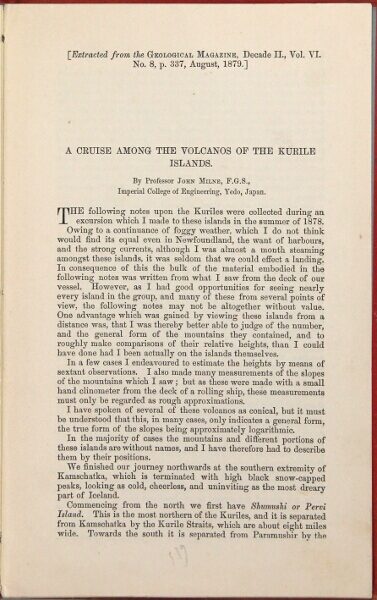
19. A cruise among the volcanos of the Kurile Islands. [London: 1879].
$125
8vo, pp. 12; lithograph chart; publisher's red cloth, gilt-stamped on upper cover; some fading on the back cover and lower corner of the upper cover, else very good, sound, and clean. Offprint, undoubtedly for the author's own use, from the Geological Magazine, Decade II, Volume VI, No. 8, for August, 1879.
John Milne (1850-1913) was a British geologist from Liverpool. He came to Tokyo in 1876 at the behest of the Meiji government to study earthquakes. Subsequently, he became one of the founders of the Seismological Society of Japan. The cruise recorded in the above offprint took place during the summer of 1878, and reached the southern extremity of the Kamchatka peninsula. In all, Milne reports on nearly two dozen islands and some 52 volcanic peaks.
Not found in OCLC.


20. Свѣдѣнія о странах по верховьям Аму-Дарьи / Svi︠e︡di︠e︡nīi︠a︡ o stranakh po verkhovʹi︠a︡m Amu-Darʹi. S.-Peterburg: Tip. V. S. Balasheva, 1879.
$2,500
First edition, 8vo, pp. viii, 270, [2]; very large folding color map; text in Russian; original printed blue-gray wrappers; some creasing, a few small chips and breaks along the extremities, but overall a very good, sound, and clean copy. Undoubtedly rare, if not very rare, in original wrappers.
Title in translation: Information about the regions of the upper Amu Darya River (West Asia, from Pamir plateau to Lake Aral).
Ivan Pavlovich Minayev (1840-1890) was the first Russian Indologist. "As a student of Vasily Vasiliev at the University of Saint Petersburg he developed an interest in Pali literature and went abroad to prepare a catalogue of Pali manuscripts at the British Museum and the Bibliothèque Nationale (still unpublished). His Russian-language Pali grammar (1872) was soon translated into French (1874) and English (1882)" (Wikipedia).
Minaev was mainly a Buddhist scholar, but also had broad interests in many sides of Indology extending to geography and ethnography. "Developing an interest in Buddhism, he went on to learn Pali and Sanskrit languages. He did considerable work on Buddhism, publishing several papers and thus laid the foundation of Buddhist studies in Russia. He held positions as an Assistant Professor, and later, Professor in the St Petersburg University. Apart from Buddhism, his papers also had commentaries on life in contemporary India. He was also a member of the Russian Geographical Society ... Minayev made three trips to India and the region. His first and longest trip was in 1874-75 in which he travelled to Ceylon (Sri Lanka), India and Nepal" (garhwalpost.in). Here, he reports on the upper reaches of the Amu Darya River (i.e., the Oxus) and the Pamir Plateau.
10 copies in OCLC, only Penn, Berkeley, LC, Columbia, NYPL, and National Academy of Sciences in the US.

21. The consumers' cooperative movement in Japan. Tokio: Sangyo-Kumiai Chuokai, 1929.
$85
First edition in English (there was a corresponding edition in Japanese published simultaneously); 8vo, pp. vi, [2], 59, [1]; 5 illustrations from photographs on 2 plates; original tan wrappers printed in green; lightly toned; a very good, sound, and clean copy. Early owner's signature on first blank flyleaf.
15 in OCLC, only Brooklyn College, NYPL, Chicago, Amherst, and the International Labor Office in the US.


22. Presentation of the relics of Commodore Matthew Calbraith Perry by his descendants to the people of Japan through the American ambassador. Tokio: The America-Japan Society, June, 1928.
$75
Only edition, 8vo, pp. [2], 39, [1]; 12 full-page illustrations from photographs including a fine portrait of Perry, other dignitaries, and the relics themselves; original printed gray wrappers, soiled, the top 3" of the upper joint torn; a good copy of an uncommon Perry item.
Ten in OCLC: Arkansas, Stanford, Yale, LC, Chicago, Harvard, LC, US Dept. of State, Swarthmore, and Alberta.


23. Kritische Durchsicht der von Dawidow verfassten Wörtersammlung aus der Sprache der Aino's. Wien: K.K. Hof- und Staatsdruckerei, 1851.
$500
First edition, 8vo, pp. 179, [1]; original printed wrappers bound in; neat modern tan cloth, title stamped in black on spine; a fine copy. Issued as a supplement to the December issue of the 1851 volume of the Proceedings of the Philosophical-Historical Class of the Imperial Academy of Sciences.
Pfizmaier (1808-1887) was one of the great linguists of the 19th century, a prolific author and master of numerous languages including Chinese, French, Italian, English, Latin, ancient Greek, Turkish and Russian, Dutch, Persian, Egyptian, Japanese and Manchurian. "In 1843 he became a lecturer in Chinese, Turkish, Arabic and Persian language and literature at the University of Vienna. In 1847, he was the first to translate a Japanese novel into a Western language: Six Screens in Figures of the Transient World by Ryūtei Tanehiko (1783–1842)" (Wikipedia). After an abortive attempt at a German-Japanese dictionary (Woerterbuch der japanischen Sprache, part I only was published in 1851), he turned to this study of the Ainu language which was published later the same year.
This is Pfitzmaier's critical rendering of Lieutenant Gavrila Ivanovich Davydov's “Dictionary of ethnolects of the peoples inhabiting the southern recesses of the Sakhalin peninsula” as published in Kruzenshtern's Circumnavigation (1812), and published the same year as Pfitzmaier's own Untersuchungen über den Bau der Ainosprache (An Investigation of the Linguistic Structure of the Aino Language), considered the first attempt at a grammatical analysis of the Ainu language.


24. Woerterbuch der japanischen Sprache. Erste Lieferung [all published]. Wien: in commission bei C. Gerold & Sohn, gedruckt bei den P. P. Mechitharisten, 1851.
$750
First edition, folio, pp. xi, [1], 79 double-page spreads (so numbered), plus 1 page numbered 80; original printed yellow wrappers; a few small chips and cracks in the spine, but generally a very good copy or better.
Beautiful production typographically made at the printing-office of the Mechitharists who specialized in the printing of Oriental and Asian works and possessed a fine array of exotic typefaces. Part 1 only was published and includes 1040 entry words, with kanji and katakana characters together with German and English equivalents on facing pages. One of the earliest works by the prolific German philologist, Pfizmaier (1808-1887), an abortive attempt at a German-Japanese dictionary, abandoned in favor of his study of the Ainu language which was published the following year.
Zaunmuller, col. 212 (erroneously giving the date as 1850), and not noticing any earlier Japanese-German dictionary; not found in Cordier. Eight in OCLC, none (today) in the US. I last catalogued this title in 2000 at which time I noted four copies in OCLC including one at the NYPL.


25. Mongols of the twentieth century. Parts I and II. Bloomington: Indiana University, 1964.
$75
First edition, 2 volumes, 8vo, pp. xxii, 510; xii, 167, [1]; printed from typescript; 84 illustrations and maps; a very good, sound, and clean copy in original pictorial wrappers. Issued as volume 37 (parts I and II) in the publisher's Uralic and Altaic series. Part II consists of a bibliography of more than 2,600 entries.
"This very useful book for all who are interested in Mongolia and the Mongols, their culture and life in the first half of the 20th century, contains ... information on the events concerning the Mongols before 1917 (Russian relations with Buryat Mongols, Buryat Mongolia, Outer Mongolia, Pan-Mongolism). The events of 1917-1921, which are then followed by what the author calls The Soviet Period, with conclusions. Then there are [no fewer than 17] appendices on Party and Government leadership of the Mongols Party, the 1960 Constitution, congresses and meetings, etc.; a partial list of former MPR Party and Government officials, Almak divisions of the MPR, nationalities, careers and jobs of Mongolians, including dissertations submitted by Mongolians to Russian educational institutions, official and semi-official representation, partial and summary information concerning the MPR's relations with foreign countries, a summary of the United Nations' consideration of the MPR's admission to the Comintern, a comparative table of the Mongolian areas, administrative history of the Mongolian areas, recent Party and Government officials of the Buryat, Kalmyk, and Tuvan ASSRs and of the Inner Mongolian Autonomous Region of China; and a record of past Tuvan Party congresses and khural sessions, and a chronology" (extracted from a review by P. Poucha in Archiv Orientali 41, 1973).


26. Lo stato presente di tutti i paesi e popoli del mondo naturale, politico e morale con nuove osservazioni e correzioni degli antichi e moderni viaggiatori, scritto in inglese dal signor Salmon, tradotto in ollandese e franzese, ed ora in italiano. Volume I, China. [Volume II, Giappone, Isole Ladrone, Filippine, e Molucche, Regni di Kochinchina, e Tonkino e della Provincia di Quansi]. Venezia: presso Giovambatista Albrizzi q. Gir[olamo], 1731-34.
$500
First edition in Italian, 8vo, 2 volumes (of 27) in 1, pp. [16], 279, [1]; [16], 511, [1]; 2 engraved emblematic title pages by Giuseppe Filosi, printed title page in red and black, 3 engraved folding maps (China, Japan, Philippines, the last two with old tape repairs on verso), 9 engraved plates (6 folding), engraved headpieces; contemporary full calf, triple blindstamped border on covers, blindstamped fleurons in the corners, gilt-paneled spine in 5 compartments, black leather label in 1 (slightly chipped); lower cover scuffed, the spine with numerous tiny wormholes, the headbands loosening; while the binding is rather shaken, and some gatherings slightly extended, the text is clean and both titles collate complete.
These are the first two volumes in the Italian edition of Thomas Salmon's Modern History, or the Present State of all Nations, being the most complete and correct System of Geography and Modern History extant in any language. The series extended to 27 volumes in all, covering many parts of the world, the last having been published in 1766. Thomas Salmon (1679–1767) was an English historical and geographical writer, and in 1839-40 he accompanied George Anson on his voyage round the world. This is his best-known work, first published in English between 1725 and 1739. It was often abridged, continued, and published under various fictitious names. A Dutch translation, in forty-four parts, appeared at Amsterdam, 1729–1820, and another Italian translation in twenty-three volumes quarto, at Venice, 1740–61.
This Italian edition not noted by Lust.


27. Kharoṣṭhī inscriptions discovered by Sir Aurel Stein in Chinese Turkestan ... Transcribed and edited by A. M. Boyer, E J. Rapson, and E. Senart. Published under the authority of His Majesty's Secretary of State for India in Council. Oxford: Clarendon Press, 1920-29.
$2,250
First edition, 3 volumes in 1, folio, pp. [6], 143, [1]; viii, 155-266, vi, [2], 267-379, [3]; text in English, with Prakrit text transliterated, and with English supporting text; 13 gravure plates of facsimiles plus a final plate of Kharosthi letters and numerals; contemporary quarter black pebble-grain morocco (likely a German binding), smooth gilt-paneled spine laid out in 5 compartments, gilt-lettered direct in 1; some scuffing and wear, small cracks starting at the top and bottom of the upper joint, otherwise a very good, sound, and clean copy. With a dozen or so typed and manuscript erudite notes in German laid in.
Volume I: Text of inscriptions discovered at the Niya site, 1901; volume II: Text of inscriptions discovered at the Niya, Endere, and Lou-lan sites, 1906-7; and, volume III: Text of inscriptions discovered at the Niya and Lou-lan sites, 1913-14. Also, with a complete index verborum.
Erdelyi 2.08.


28. Chiwa: rapports ... traduits de l'allemand par A. Wachter. Paris: Berger-Levrault & Cie., Librairies-Editeurs, 1874.
$750
First edition in French following the German edition of the previous year; 8vo, pp. [4], iii, [1], 110; 5 folding maps (same as in the German edition), each with hand-coloring; contemporary quarter black morocco over marbled boards; edges rubbed and lightly scuffed, else a very good, sound copy.
Report of the successful Russian expedition and military operation against Khiva in 1873 which resulted in Khiva becoming a Russian protectorate.
Twelve in OCLC, only Boston Athenaeum, Harvard, Minnesota, and South Carolina in the US.


29. The Lankavatara Sutra. Translated for the first time from the original Sanskrit . London: Routledge & Kegan Paul Ltd., [1968].
$100
8vo, pp. xliv, [1], 300; frontispiece, 7 folding plates of text in 5 languages at the back (Sanskrit, Sung, Wei, T'ang, and Tibetan, each with English translation); fine copy in original brown cloth, gilt-stamped spine, in a fine dust jacket.
Together with: Suzuki, Daisetz Teitaro. Studies in the Lankavatara Sutra. One of the most important texts of Mahayana Buddhism, in which almost all its principal tenets are presented, including the teaching of Zen. London: Routledge & Kegan Paul Ltd., [1975]. 8vo, pp. xxxii, 464; frontispiece; fine copy in original brown cloth, gilt-stamped spine, in a fine dust jacket.
The Lankavatara Sutra is one of nine principal texts of Mahayana Buddhism. Lanka is one of the islands in the south of India, identified as Ceylon and Lankavatara literally means "entering into Lanka" and refers to the Buddah's "entering" to that island.
Together 2 matching volumes, sixth and fifth impressions respectively, in fine condition. Daisetz Teitaro Suzuki (1870-1966) "was a Japanese essayist, philosopher, religious scholar, and translator. He was an authority on Buddhism, especially Zen and Shin, and was instrumental in spreading interest in these to the West. He was also a prolific translator of Chinese, Korean, Japanese, Vietnamese and Sanskrit literature" (Wikipedia).


30. Voyage dans l'Asie centrale de Téhéran à Khiva, Bokhara et Samarcand. [Paris: Hachette, July, 1865].
$350
Folio extract from Le Tour du Monde, volume 12, and the first edition in French, comprising pages 33-112 (i.e. 80 pages); text in double column, full-page map, 34 fine wood-engraved illustrations by Emile Bayard, and others; later quarter calf and marbled boards, green leather label on spine; very good, sound, and clean.
"The real novelty of the French version by Hachette was the wealth and quality of the illustrations. Not only were most of the engravings of the [London] Murray edition taken over, but new illustrations were added, courtesy of Émile Bayard (1837–1891), one of the main illustrators of Le Tour du Monde and the Hachette publisher. These were already published in the journal, and the independent volume was completed with 34 woodcut plates, 23 of which were the work of the French artist. The main picture is the opening illustration of the book, depicting Vámbéry in his simple travelling costume, with his bag at his side, a hatchet in his hand and his donkey beside him. The full name of the draughtsman is in the lower left-hand corner and the engraver, J. Huyot, is on the right. The caption in the volume is simply the author's name: Arminius Vambéry. The publication in the journal which, as mentioned, was published in July 1865, is more detailed:
“Arminius Vambéry. – Drawing by Émile Bayard from a photograph.” No similar statement is made about the other pictures, but it is stated that the engravings were made “after Vambéry.” The Bayard illustrations always bear the author's signature; those taken from the English edition are anonymous. This suggests that of the 34 pictures, only one, the one of Vambéry with his donkey, had a photographic basis, the others were based on narratives."
This is the first appearance in French of Vámbéry's extraordinary journey, albeit in abridged format for Le Tour du Monde. (See: Zoltán Fejős's "Testimony and Role Play: Portraits of Ármin Vámbéry, 1864–1865"). Wikipedia notes the details of the Hungarian Vámbéry's travels. In the autumn of 1861, "disguised as a Sunni dervish, and under the name of Reshit Efendi, he set out from Constantinople. His route lay from Trebizond on the Black Sea to Tehran in Persia, where he joined a band of pilgrims returning from Mecca, spending several months with them traveling across Central Iran (Tabriz, Zanjan, and Kazvin). He then went to Shiraz, through Ispahan, and in June, 1863, he reached Khorezm (Central Asia). Throughout this time, he succeeded in maintaining his disguise as "Reshit Efendi," so that upon his arrival at the Khanate of Khiva he managed to keep up appearances during interviews with Khan Sayyid Muhammad. Together with his band of travelers, he then crossed Bokhara and arrived at Samarkand. Initially, he aroused the suspicions of the local ruler, who kept him in an audience for a full half-hour. Vámbéry managed to maintain his pretenses, and left the audience laden with gifts. Upon leaving Samarkand, Vámbéry began making his way back to Constantinople, traveling by way of Herat. There he took leave of the band of dervishes and joined a caravan to Tehran, and from there, via Trebizond and Erzurum, to Constantinople, arriving there in March 1864.
"This was the first successful journey of its kind undertaken by a European; and since it was necessary to avoid suspicion, Vámbéry could not take even fragmentary notes, except by stealth. After a long and perilous journey, he arrived back at Pest in May 1864. He went to London to arrange the English language publication of his book about the travels. Travels in Central Asia [published in 1864] and its Hungarian counterpart "Közép-ázsiai utazás" was published in 1865."


31. The playground of the far east. [Foreword by Professor Shigetaka Shiga]. London: John Murray, 1918.
$750
First edition, 8vo, pp. xii, [2], 333, [1], [4] ads; 2 folding color maps, 20 illustrations from photographs on 17 plates; original red cloth stamped in gilt on spine; spine considerably faded; the very rare dust jacket is present but the spine of the jacket has been rejointed which explains the faded cloth on the spine; in all a good, sound, and clean copy, in a good dust jacket with small chips at the extremities and the joints repaired.
Walter Weston (1861-1940) was an English clergyman and Anglican missionary who helped popularize recreational mountaineering in Japan. He spent 15 non-consecutive years there between 1888 and 1915, wrote Mountaineering and Exploration in the Japanese Alps which was published in 1896, and was one of the founding members of the Japanese Alpine Club in 1906.
Chapters include: Mountains & mankind in Japan -- Annals of Fuji-san -- Exploration in southern Alps of Japan -- Northern Alps revisited -- Human interest -- Making of soldier in modern Japan -- Sports & pastimes in ancient & modern Japan -- Rural Japan all year round -- Greece of far east -- Envoy to mountaineers of Japan.


32. The science of religion ... Fifth edition. Los Angeles: Yogoda and Sat Sanga Headquarters, 1926.
$75
Small 8vo, pp. xv, [1], 107, [5]; portrait frontispiece; original terracotta cloth stamped in gilt on upper cover and spine; slight stain along the gutter-edge of the upper cover; all else very good, sound, and clean.
"Paramahansa Yogananda (1893-1952) was an Indian-American Hindu monk, yogi, and guru who founded the Self-Realization Fellowship (SRF)/Yogoda Satsanga Society of India (YSS), a religious meditation and Kriya Yoga organization, to disseminate his teachings ... He immigrated to the US at the age of 27, intending to demonstrate a unity between Eastern and Western religions and advocate for a balance between Western material growth and Indian spirituality. His longstanding influence on the American yoga movement, and especially the yoga culture of Los Angeles, led yoga experts to consider him the 'Father of Yoga in the West'" (Wikipedia).