

Recent Acquisitions
May 12th, 2026
To order call toll-free at (800) 441-0076 or 651-290-0700
or email rulon@rulon.com
or, click on the "add to cart" link to order through our website. Phone calls and emails are generally quicker.
All books are guaranteed genuine as described, and are returnable for any reason during the first week after receipt. If you are returning an item, please let us know so we can make it available to another customer.
Shipping and handling charges are extra and billed at cost.


A note on OCLC
As is now the norm, OCLC counts are tentative, at best, as we recognize that searches using different qualifiers will often turn up different results. Searches are now further complicated by the vast numbers of digital, microfilm, and even print-on-demand copies, which have polluted the database considerably, making it difficult, without numerous phone calls or emails, to determine the actual number of tangible copies. Hence, even though the counts herein have been recently checked, most all should be taken as a measure of approximation.


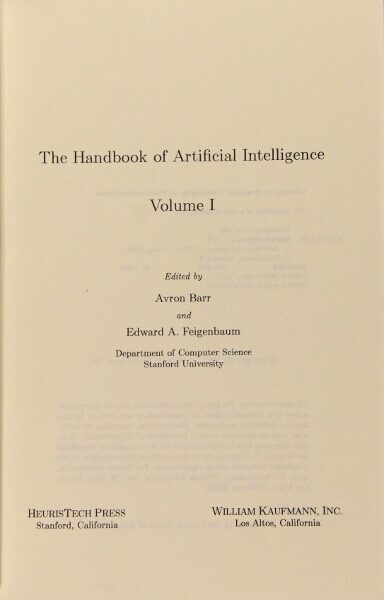

1. The handbook of artificial intelligence. Stanford: HeurisTech Press; Los Altos: William Kaufmann, Inc., [1981-82].
$150
3 volumes, fifth, third, and fourth printings respectively; very good to near fine copies in the dust jackets. A fourth volume was published seven years later in 1989.
"Artificial Intelligence (AI) is the part of computer science concerned with designing intelligent computer systems, that is, systems that exhibit the characteristics we associate with intelligence in human behavior - understanding language, learning, reasoning, solving problems, and so on. Many believe that insights into the nature of the mind can be gained by studying the operation of such programs. Since the field first evolved in the mid-1950s, Al researchers have invented dozens of programming techniques that support some sort of intelligent behavior. The Handbook of Artificial Intelligence is an encyclopedia of the major developments of the field's first 25 years - programs, programming techniques, and the computational concepts used to describe them. Whether or not they lead to a better understanding of the mind, there is every evidence that these developments will lead to a new, intelligent technology that may have dramatic effects on our society" (introduction).

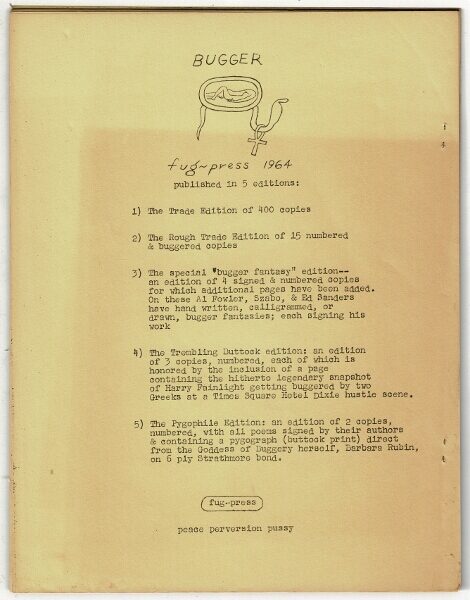
2. Bugger an anthology of anal erotic, pound cake cornhole, arse-freak, & dreck poems. New York City: The Fuck You Press, 1964.
$225
Side-stapled, 11" x 8½", [3] p.l., 19 leaves printed from typescript on yellow and pink paper on rectos only, plus a final (20th) leaf (back cover) printed only on the verso; near fine.
Edition limited to 424 copies, this being one of 400 in the trade edition.
Contains poems by Szabo, Allen Ginsberg, Ed Saunders, Ted Berrigan, John Harriman, Ron Padgett, Al Fowler, John Keys, and Harry Fainlight.

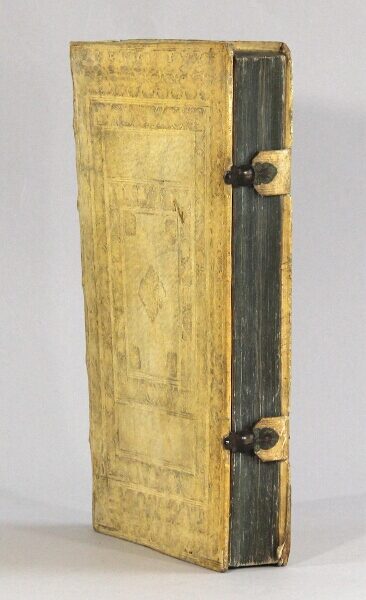


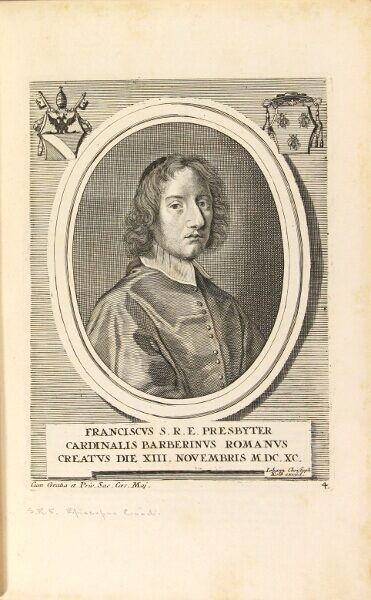
3. Roma Sancta sive Benedicti XIII. Pontificis maximi & eminentissimorum & reverendissimorum S.R.E. Cardinalium viva virtutum imago aeri & literis in perennaturam virtutum memoriam incisa. Continentur vitae, familiae, patriae, legationes, aliáque scitu & memoratu digna omnium S.R.E. cardinalium qui ultimo conclavi anno 1724 interfuêre. Praeter eos qui à sanctissimo Patre Bendedicto XIII. Augustae Vindelicorum: 1726.
$750
Folio, pp. [8], 202; engraved title page, printed title page in red and black; engraved portrait of Pope Benedict XIII, plus 71 engraved portraits by Johann Christoph Kolb of Augsburg, 2 engraved headpieces and 2 engraved initials, woodcut ornaments and tail-pieces throughout; contemporary full blindstamped pigskin, gray edges, 2 brass clasps, manuscript title on spine, contemporary ex libris in ink at te top of the title page; a very good, sound, and clean copy. With the 19th century armorial bookplate of Fred. William Hope, and the Abbot Hermann von Roth, and a 20th-century bookplate of J. K. Dowling.
First edition of an interesting and beautifully illustrated history of the conclave which ended with the election of Benedict XIII (Orsini) on 29 May 1724, including biographies of the new pope and all the cardinals who attended the conclave, as well as details of the various legations and missions sent to the conclave by the European powers.
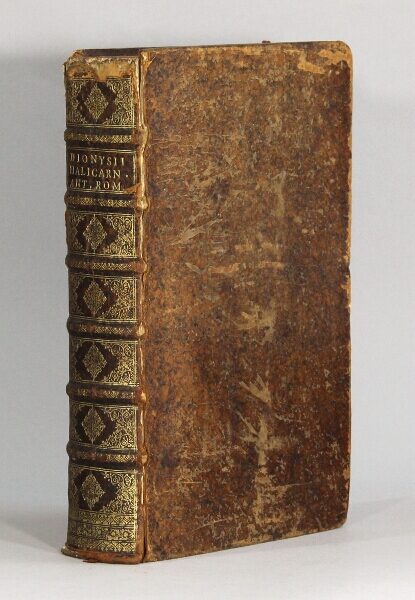

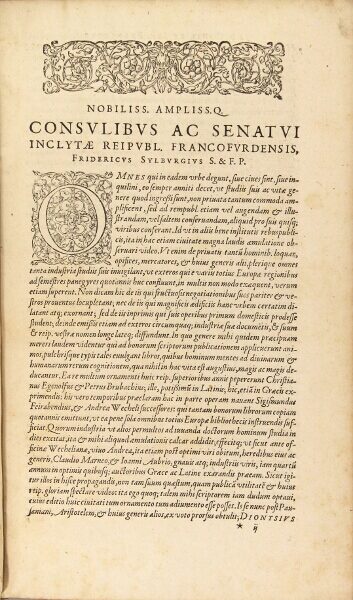


4. Διονυσίου Ἁλικαρνασσέως τὰ εὑρισκόμενα, ἱστορικά τε καὶ ῥητορικὰ, συγγράμματα = Dionysii Halicarnassei scripta quae extant, omnia, et historica, et rhetorica ... Opera & studio Friderici Sylburgii Veterensis. Francofurdi: apud heredes Andreae Wecheli, 1586.
$1,250
First edition of the author's complete works; folio, 2 volumes in 1, pp. [16], 792, 169, [3]; [12], 280, 94; woodcut printer's device on both title pages with initials AW, woodcut device on verso of last leaf in the first volume, but lacking in the second (leaf mm2); woodcut initials and head-pieces; chronological tables on pp. 750-771 in the first volume; volume I has Greek text and Latin translation in parallel columns; volume II has Greek text followed by a Latin translation. Engraved armorial bookplate of Sir George Shuckburgh, Bart. (1751-1804), the British mathematician and astronomer.
The text is preceded by Sylburg's dedicatory epistle to the Senate of Frankfurt and his preface to the reader. Dionysius of Halicarnassus (ca. 60 BC to after 7 BC) was a Greek historian and teacher of rhetoric. His history of Rome was his most important work, and he also wrote several books on rhetoric and style.
Adams, D-625; Brunet, II, 725; Graesse II, 400.


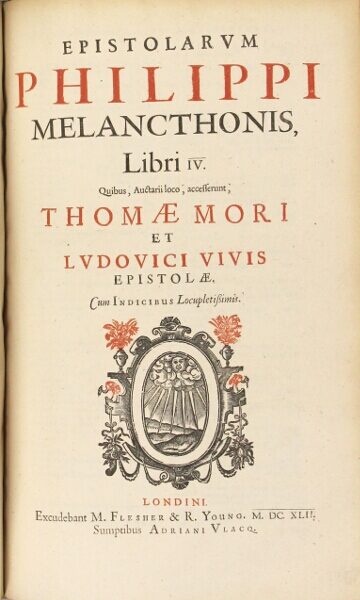
5. Epistolarum D. Erasmi Roterodami libri xxxi. Et P. Melancthonis libri iv Quibus adjiciuntur Th. Mori & Lud. Vivis epistolae. Vnà cum indicibus locupletissimis. London: M. Flesher & R. Young ... Sumptibus Adriani Vlacq, 1642.
$950
First edition of this collection of the letters of Erasmus, the most complete that had been compiled to date, and the first printed in England; folio, 2 volumes in 1, as issued; pp. [36], 2146 columns, pp. [37]; pp. [12], 968 columns, 116 columns, pp. [10]; both titles printed in red and black; text largely in double column; engraved frontispiece portrait of Erasmus after William Marshall, woodcut initials; full contemporary calf, black morocco label on spine; joints cracked, cords holding; frontispiece with light spotting in the margins; a good copy, and while the joints are cracked, the sewing structure is quite sound. An imperfect copy, lacking 3K2 and 3K5 in the first part, and B1 and B6 in the second part - almost certainly binder's errors. Engraved armorial bookplate of Prince Augustus Frederick, Duke of Sussex (1773-1843).
"Epistolarum Philippi Melancthonis" (Wing M1635A) has separate dated title page, pagination and register, and the "Auctarium epistolarum ex Thoma Moro" (caption title) has separate pagination and register.
Includes a Life of Erasmus and selected letters of Erasmus' correspondents, the reformer Philip Melancthon, Thomas More, and the Spanish humanist, Juan Luis Vives. There were four editions of Erasmus' letters published in Basel between 1521 and 1541 (each larger than the previous), and no other collected edition until this London edition of 1642. This edition, though not always accurate by modern standards, represents a remarkable achievement in English scholarship. The editors made an exhaustive search through continental libraries for original, unpublished letters as well as those which had already found their way into print. A number of the letters here have since perished, and this collection preserved the most authoritative text of Erasmus' letters until the definitive edition of the Epistolae appeared in Oxford in 12 volumes, 1908-58.
Wing E3201 and M1635A. ESTC R218212.


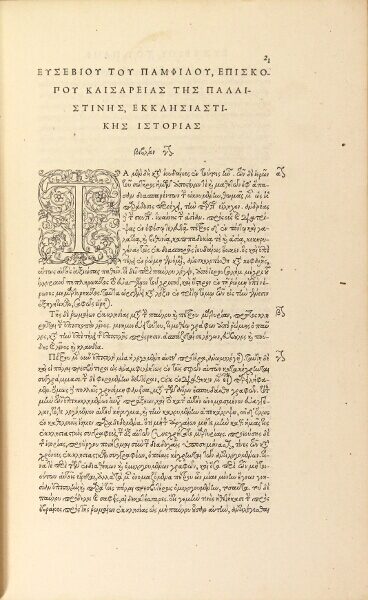
6. Ekklēsiastikēs historias ... Ecclesiasticae historiae : Eusebii Pamphili lib. X, eiusdem de vita Constantini lib. V, Socratis lib. VII, Theodoriti episcopi Cyrensis lib. V, collectaneorum ex historia eccles. Theodori Lectoris lib. II, Hermii Sozomeni lib. IX, Euagrii lib. VI. Lutetiae Parisiorum: ex officina Roberti Stephani ... cum privilegio Regis, 1544.
$5,000
First edition of Eusebius's complete works, a collection of Greek writings on the early Church, written by Eusebius between 300-325 AD with continuations into the 5th century by Sozmen, Socrates (of Constantinople) and Theodoret, and the debut in print of the Grecs du roi typeface designed by Claude Garamond.
Folio, 2 parts in 1, ff. [4], 353 [i.e. 362], 181, [5] leaves (including the final blank); collating: **⁴ A-X⁸ Y-3E⁶ 3F⁸ 3G⁶, ²2A-3H⁶, P5; printer's wooodcut basilisk device on title page and olive tree on verso of penultimate leaf, 47 large (9-line) woodcut initials, 7 woodcut headpieces; 18th-century full calf, double gilt rule on covers, gilt-paneled spine in 6 compartments, black leather labels lettered in gilt in 2; upper joint cracked, spine lightly chipped at the extremities, several minor worm holes in the blank fore-margins of the first third of the text; a very good, clean copy, Bookplate of William Markham, Esq. (1760-1815, private secretary to Warren Hastings), Becca Lodge, Yorkshire.
The most famous of all Greek types, known as the Grecs du roi or the Royal Greek Types, owe their origin to the scheme of Francis I to encourage Hellenic learning by making available in print Greek manuscripts in the French Royal Library. Conrad Neobar, who was the first to hold the official title "King's Printer in Greek," died in 1540 and was succeeded by Robert Estienne. In 1541, a Treasury grant was made to Estienne to obtain punches for a Greek font, which resulted in the Royal Greek Types. They were executed by Claude Garamond and were based on the calligraphy of the Cretan Angelo Vergecio, a copyist and cataloguer of the Royal manuscripts. The first book to be printed entirely in the new types was the Eusebius of 1544. Originally, it was intended to be cut only one size, the great primer, but a smaller and larger were soon prepared. Paradoxically, the enormous success of the new types had unfortunate consequences. They virtually arrested any development in Greek typography for the next two hundred years. To imitate the involved cursive hand of Vergecio, an enormous number of ligatures and contractions were required, and by no means all subsequent users of the types or their derivatives achieved the brilliant effect of Estienne's productions. The Eusebius is outstanding not only for its typographical importance and magnificence but, according to Updike, also for containing the most brilliant impression of the beautiful initials and headpieces which are based on the illuminated decorations with which Vergecio embellished his texts.
Adams E1903; Mortimer, French, 219; Schreiber, 77; Printing and the Mind of Man (exhibition catalogue) no. 3. Updike, Printing Types, I, pp. 237-8.

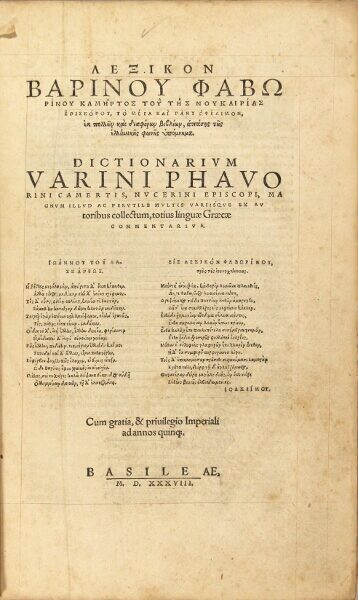


7. [Lexikon Barinou Phabōrinou Kamērtos...]. = Dictionarium Varini Phauorini Camertis, Nucerini Episcopi, magnum illud ac perutile multis uariiśque ex autoribus collectum, totius linguæ Græcæ commentarius. Basileae: [Roberto Cheimerino = Winter], 1538.
$4,500
Second edition, folio, pp. [8], 1900 columns, pp. [1]; [210] index; printer's woodcut device on verso of final leaf; lightly ruled in red throughout, woodcut initials and ornaments; scruffy old calf, gilt spine considerably rubbed and worn, joints cracked, cords holding; internally clean with perhaps 100 early and informed annotations in the margins. Armorial bookplate of Sir Edward W. Watkin, Rose Hill, Northenden, the MP and railway entrepreneur.
This copy includes the very extensive index which is not in all copies.
Guarino (ca. 1450-1537), an Italian Benedictine monk, was one of the most significant 16th-century lexicographers. He was appointed bishop of Nocera in 1514 and is best known for producing the first Thesaurus Linguae Graecae. "In 1523 appeared his Etymologicum magnum, sive thesaurus universae linguae Graecae ex multis variisque autoribus collectus, a compilation which has been frequently reprinted, and which has laid subsequent scholars under great though not always acknowledged obligations" (EB).
Adams P-984; Vancil, p. 104.


8. [India.] Illustrated India: its princes and people. Upper, central, and farther India, up the Ganges and down the Indus. To which is added an authentic account of the visit to India of His Royal Highness, The Prince of Wales ... containing 123 full-page engravings and maps. Hartford: American Publishing Company, 1877.
$125
First edition, 8vo, pp. xvi, [4], 17-628; illustrated throughout with wood engravings; original red cloth stamped in gilt and black on upper cover and spine; rebacked, the old spine laid down, endpapers renewed; binding with scrapes and wear, but the binding is sound and the text clean.
The author was the wife of the U.S. Counsel in India. This appears to be her only work.


9. [India.] Four years' campaign in India. London: Hodder and Stoughton. New York: Nelson & Phillips, 1875.
$150
First edition, 12mo, pp. xix, [1], 416; wood-engraved frontispiece and 2 wood-engraved plates, tables in the text (4 double-page); spine ever-so-slightly sunned, else a near fine copy in original purple cloth, gilt-stamped spine, a.e.g.
William Taylor (1821–1902) was an American Methodist missionary minister who initially established a mission in California to serve the prospectors and gold miners in 1849. He wrote numerous books on his "extensive missionary travels includ[ing] Australia and South Africa (1863-1866); England, the West Indies, British Guiana, and Ceylon (1866-1870); India (1870-1875); South America (1875-1884); and Liberia, Angola, the Congo, Australia and Mozambique, a global involvement unmatched by no other during his time (1885-1896)" (Wikipedia).


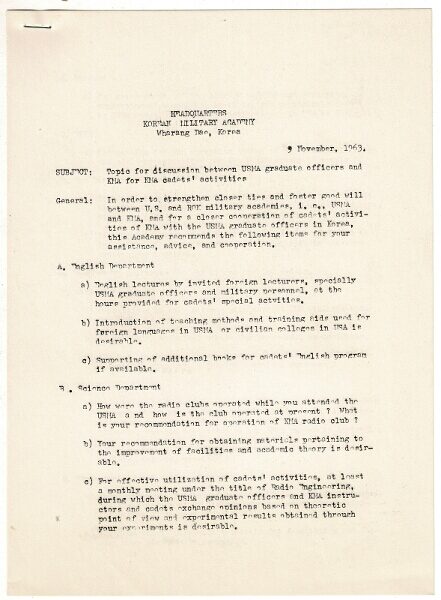
10. Korean Military Academy 1963. [Wharang Dae, Korea: Korean Military Academy, 1963].
$150
Small bifoliate packet approx. 12" x 9½" containing an 11" x 8½" 2-page mimeograph stat sheet outlining cadets' potential studies in the English and Science departments, the Academy's library, museum, and athletics programs, as well as a 52-page 11" x 8½" booklet with many photographic illustrations of the academy, and the cadets and instructors at work and play; the packet a bit creased at the top extremity but the contents are generally fine. Bilingual text in Korean and English.
Not found in OCLC.
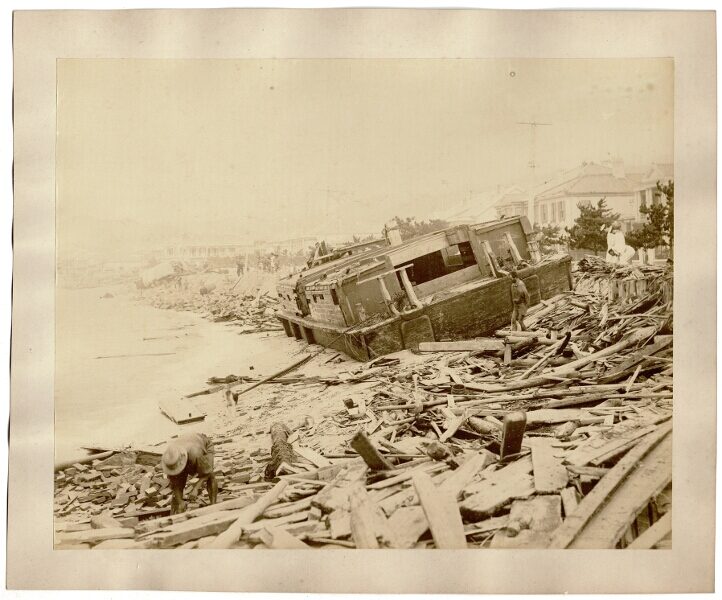
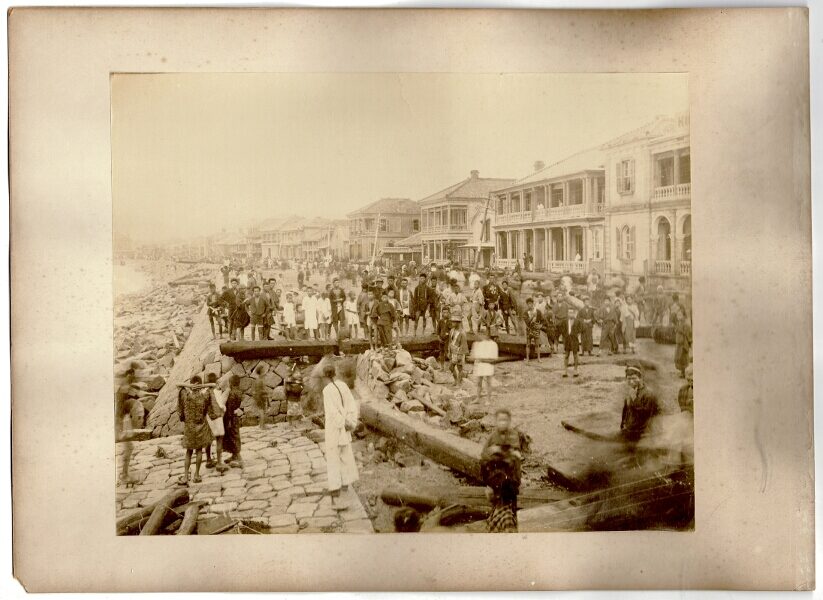

11. Nine vintage photographs taken following the 1891 typhoon in Kobe. [Yokohama?, Japan: ca. 1891].
$2,000
Albumen photographs, each approximately 8" x 10" on mounts varying from 10" x 14" to 8¼" x 10½", showing the mayhem, including destroyed watercraft in the harbor, a ruined bridge, waterfront wreckage, and a large group of townsfolk looking dejected while also looking curiously at the photographer. Some curling of the images, one with a short tear in the margin, but generally very good. Apparently taken from an album, as one has two other unrelated photographs on the verso.
Kusakabe Kimbei (1841-1932) "remains one of the most underrated Japanese photographers of the nineteenth century. Because of his concentration on producing souvenir albums containing hand-colored views and costumes for foreigners he is better known today in the West than he is in Japan. For today's collectors of early photograph albums, pride of place will always be given to Felix Beato and Raimund von Stillfried for their respective output in the 1860s and 1870s. However, from the 1880s onwards no studio comes close to matching Kusakabe's for the consistent quality and variety of its output" (Bennett, Photography in Japan).


12. Corpus iuris canonici emendatum et notis illustratum: Gregorii XIII. Pont. Max. iussu editum. Nunc indicibus nouis, & appendice Pauli Lanceloti Perusini adauctum. Parisiis: [Compagnie de la Grand Navire], cum licentia, 1587.
$2,500
Folio, pp. [50], 454, [12]; title printed in red and black, printer's ship device on title page, woodcut initials and ornaments, full-page woodcuts on [alpha]6v, [gamma]8v, ll2, and ll3 (the last 2 with small damstains at the top). Not found in Adams.
Bound with, as issued: Gregorious IX, Papa. Decretales D. Gregorii papae IX suae integritati restitutae. Parisiis: cum licentia, 1587. Folio, pp. [2], 459-727, [1]; title printed in red and black, printer's ship device on title page, woodcut initials and ornaments. Not found in Adams.
Bound with, as issued: Bonifatius VIII, Papa. Liber sextus Decretalium D. Bonifacii Papae VII. Parisiis: cum licentia, 1587. Folio, pp. [8], 731-885, [1]; title printed in red and black, printer's ship device on title page, woodcut initials and ornaments, full-page woodcuts on *4v. Not found in Adams.
Bound with, as issued: Lancellotti, Giovanni Paolo. Institut, iuris quibus ius pontifium singulari methodo libris IV. Parisiis: cum privilegio regis, 1587. Folio, pp. 72, [160]; title printed in red and black, printer's ship device on title page, woodcut initials and ornaments; neat early repair to the blank fore-margins of the last two leaves. Adams L-104.
Continuous register: [alpha]6, [beta]-[gamma]8, [delta]4 (delta3 missigned), A-2O6, 2P4, 2Q6, 2Q(rep.)-2Z6, 3A-3O6, 3P4, [asterisk]4, 3Q2-3Z6 (-3Q1), 4A-4D6, 4E7 (-4E8), a-l6, m4, n-t6, v4. Blank leaves 3Q1 and 4E8 are not present. Otherwise, an hour later, collated complete!
An edition likely issued by the Compagnie du Grand Navire, a consortium formed for the publication of the works of the Church Fathers. The volumes bear no imprint, but feature a ship as their device. From 1585 to 1589, the ship displays within its masts the initials I.D.P., S.N., M.S., and B.D.P., representing Jacques Du Puys, Sébastien Nivelle, Michel Sonnius, and Baptiste Du Puys.
Based on the Roman edition of 1582 but without the gloss. Apparently. originally issued in 2 (unnumbered) physical volumes. Lancellotti owes his world-wide reputation to his Institutiones Juris Canonici, the text of which is reproduced in most editions of the Corpus Juris Canonici, as here. This is his major work, a broad survey of the fundamentals of Catholic canon law which was modeled on the Institutes, a similar survey of Roman law commissioned by the Byzantine Emperor Justinian. The Institutiones are divided into four books, and treat successively of persons, things (especially marriage), judgments, and crimes.
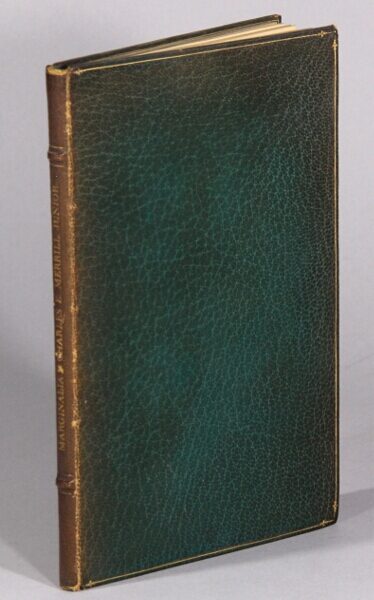

13. Marginalia. New York: privately printed, 1902.
$175
"Sixty-two copies of the book were printed in February, 1902, of which two copies were on vellum. This is number 1" (on japon vellum), 8" x 5¼", pp. 47, [3]; contemporary full crushed green morocco, gilt rule on covers, gilt-stamped spine; joints tender, spine browned; very good copy.
"This book was arranged for the press by W. A. Bradley, New York, 1902" (final leaf).
Charles Edmund Merrill Jr. (1877-1942) was born in New York in 1877 and graduated from Yale University in 1898. The following year he enlisted in the army where he saw service during WWI and attained the rank of Major before being discharged in 1919. Merrill married Ethel Revere Moses, and they had one daughter, Lydia. He was president of the Charles E. Merrill Publishing Company, publishers of readers, spelling books, grammars, mathematical texts, and other text books.


14. [Numismatics.] Seleucidarum imperium, sive Historia regum Syriæ, ad fidem numismatum accommodata ... Editio secunda, nitidior et emendatior. Hagæ-Comitum: apud P. Gosse & J. Neaulme, 1732.
$1,250
Folio, pp. [16], 274; title page printed in red and black with engraved vignette, engraved illustrations of Seleucid coins throughout the text, including chapter headings depicting each ruler, woodcut head- and tail-pieces, factotum initials; text in Latin text with some Greek quotations;19th century half pebble-grain morocco, gilt-paneled spine in 6 compartments, gilt-lettered direct in 3; lightly rubbed; very good. Armorial bookplate by John Vinycomb of William Charles De Meuron, [7th] Earl Fitzwilliam (1872-1943).
"The first book devoted solely to ancient Seleucid coins ... comprises an authoritative history of the Seleucid Dynasty in Syria, based largely on the author's extensive collection. In this enlarged edition, each ruler is depicted with a handsome large format portrait taken from a coin, followed by commentary and illustrations of his coins. Jean Foy Vaillant (1632-1706) was a dedicated and scholarly French numismatist and collector of coins who authored a large number of important numismatic works on ancient coins. This particular title is considerably scarcer than many of his works..." (Kolbe & Fanning).
Blackmer Sale 121; Brunet 29770; Goldsmiths'-Kress 07049.
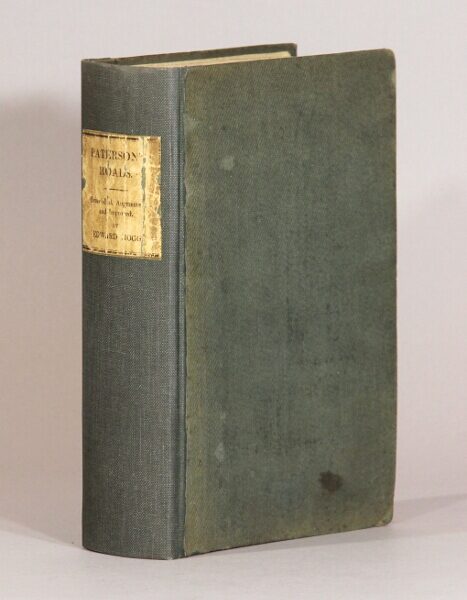
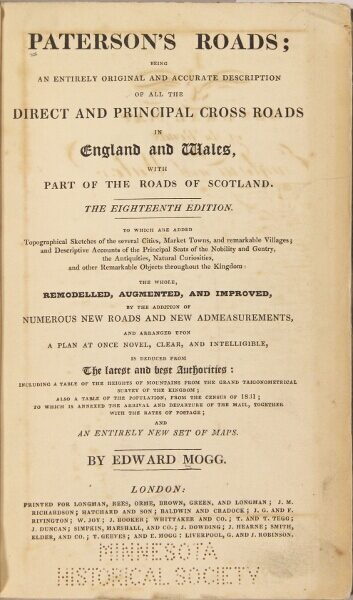

15. Paterson's roads; being an entirely original and accurate description of all the direct and principal cross roads in England and Wales, with part of the roads of Scotland. The eighteenth edition. To which are added topographical sketches of the several cities ... and descriptive accounts of the principal seats of the nobility and ... the antiquities ... throughout the kingdom: the whole remodelled, augmented and improved ... with an entirely new set of maps. London: Longman, Rees, Orme [et al.], n.d., [1829-32].
$500
Thick 8vo, pp. 6, *6, [7]-82, 715; large folding frontispiece map and 10 maps on 7 folding plates at the back; bound with: Appendix to the eighteenth edition, [London, 1828], pp. iv, [2], 44; frontispiece map; original green cloth, rebacked with original printed paper label laid down; ex-MHS with perforated stamp at the bottom of the title page (not touching the imprint), and the MHS bookplate marked withdrawn.
Originally published as A New and Accurate Description of all the Direct and Principal Cross Roads in Great Britain in 1771 (later, Paterson's British Itinerary); this is the final revision of the book, published successively in 1826, 1828, and in undated issues in 1829 and 1832. This is the largest and most complete text.
For a good history of this famous guide book see Herbert Fordham's article in the Transactions of the Bibliographical Society, The Library, Vol. 5, 1924-5, pp. 333ff.


16. From the Arctic Ocean to the Yellow Sea. The narrative of a journey in 1890 and 1891, across Siberia, Mongolia and the Gobi Desert and North China. New York: Charles Scribner's Sons, 1892.
$250
First American edition, 8vo, pp. xxiv, 384; gravure frontispiece portrait, folding map printed in color; 142 illustrations from sketches by the author, 42 of which are on plates; previous owner's small bookplate; publisher's pictorial blue cloth stamped in gilt and silver; a near fine, sound copy.
Price "was educated at University College London and studied art in Brussels and at the École des Beaux Arts, Paris. He was a special war artist and correspondent for the Illustrated London News. For journalist purposes he enlisted as a trooper in Methuen's Horse and served in the Bechuanaland campaign 1884–1885 and continued serving with the regiment until it was disbanded. During 1890–1891 he joined an exploration expedition to open up the Nordenskiöld route to the interior of Siberia via the Kara Sea, the Arctic coast of Siberia, and along the Yenisei River; after the expedition he travelled unaccompanied by westerners across Siberia, Mongolia including the Gobi Desert, and North China to Beijing" (Wikipedia).

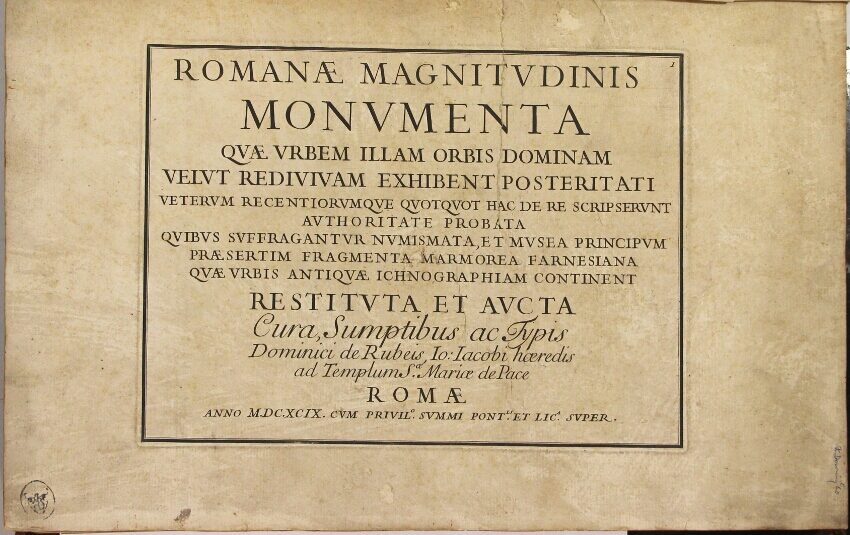


17. Romanæ magnitvdinis monvmenta, qvæ vrbem illam orbis dominam velvt redivivam exhibent posteritati, vetervm recentiorvmqve qvotqvot hac de re scripservnt avthoritate probata, qvibvs svffragantvr nvmismata, et mvsea principvm præsertim fragmenta marmorea Farnesiana, qvæ vrbis antiqvæ ichnographiam continent, restitvta et avcta cura, sumptibus ac typis Dominici de Rubeis. Romae: ac typis Dominici de Rubeis, 1699.
$5,000
Folio, 138 copper engravings, including the title page and dedication; title leaf soiled, title and dedication both with neatly repaired 4½" tears (no loss), all other engravings clean and without flaws; slightly later full speckled calf, spine worn, joints cracked (cords holding), flyleaves loosening. Beautiful impressions of the plates on heavy paper. Armorial bookplate of Percy, Algernon, 4th Duke of Northumberland (1792-1865).
Originally published as Antiquae urbis splendor 1637. "This new 'edition' contains all the plates from libri I-III of Lauro's original work, one plate from liber IV, a new title-plate, and 16 new plates by Bartoli. In this form the work was reprinted many times, first by Domenico de Rossi, and subsequently, after the de Rossi stock was transferred to its collections, by the Calcografia della Camera Apostolica. It continued to be offered for sale well into the nineteenth century ... Many of the plates are renumbered and in many cases retouched, with the borders thickened, and with altered or additional wording to the captions in some plates" (British Architectural Library).
"Most plates (unsigned) are reworked plates from Giacomo Lauro's Antiquae urbis splendor. Pietro Santi Bartoli as engraver has signed nos. 2, 48-55, 64, 76-79, 92, 128-129, which also carry the line: Ex officina Dominici de Rubeis (or, Dominicus de Rubeis hered. Io. Iacob' de Rubeis formis Rome) ad templu Sae. Mae. de Pace. Plates 53-55 are signed "Ab equite Petro Berettino Cortonensi delineata" (Millard, Italian, 55).
Early Printed Books: 1478-1840. Catalogue of the British Architectural Library, 1781; Brunet IV, 1405; The Mark J. Millard Architectural Collection, volume IV, Italian and Spanish Fifteenth through Nineteenth Centuries, 55.

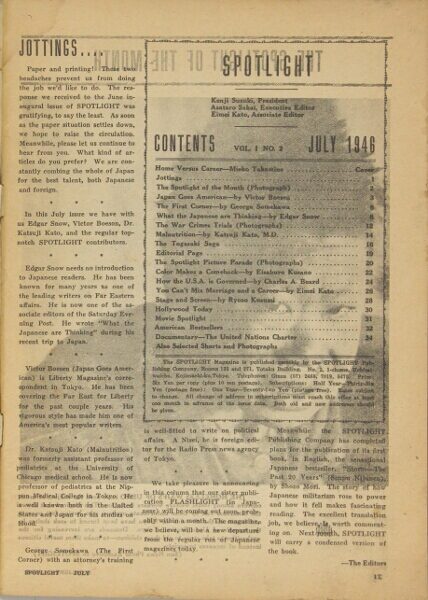

18. Spotlight. vol. 1, no. 2. Tokyo: Spotlight, 1946.
$150
10 x 7.25 in., pp. 48; text illustrations; pictorial paper wrappers; tidestain on lower wrapper, some production problems leading to bleed through of text on leaves, very good.
A full-English magazine published in Japan in the early years of the occupation. The contributors were largely foreigners, including many Japanese-Americans who had come to Japan to support the occupation. Material includes both politics and popular interest, with articles on war crimes trials, photos of "Miss Occupation" contestants, a portrait of an impoverished Tokyo orphan, imported American movie news, keeping up on modern fashion via the black market, a spotlight on the actress Mieko Takamine, and an article on malnutrition. Contributors include Edgar Snow and Esaburo Kusano. The paper and printing of the magazine itself reflects the shortages of the time. The paper is toned, and the printing is of poor quality, rendering a few pages difficult to read.
A scarce title. Only one copy of the first number is recorded in OCLC, at the Singapore Institute of SE Asian Studies, and no issues appear to be available anywhere else. Although Spotlight seems to have high aspirations, we would not be surprised if it failed to survive much past this second issue.

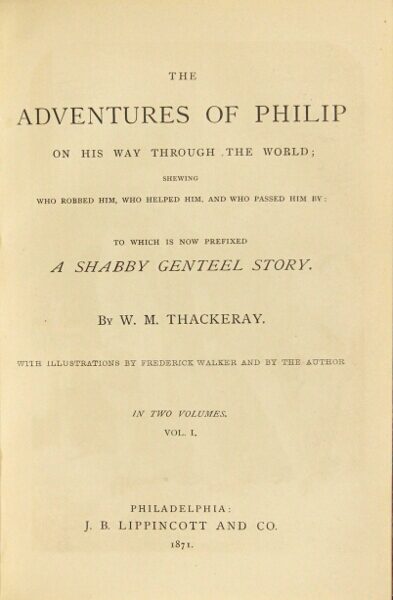


19. Works. Philadelphia: J. B. Lippincott and Co., 1872.
$500
22 volumes, 8vo, illustrated with plates throughout after those of the original editions, by the author, Richard Doyle, George Du Maurier and Frederick Walker; light occasional wear, a few of the fore-corners bumped and scuffed; in all, a very good to near fine set in publisher's half red morocco over marbled boards, gilt-decorated spines in 6 compartments, gilt-lettered direct in 1, marbled edges. This set first published in London in 1869, the first collected set of Thackeray's works, here in it's American issue.
With the early ownership signature in each volume of Mary J. Foster, 1874.
CBEL III, 429.

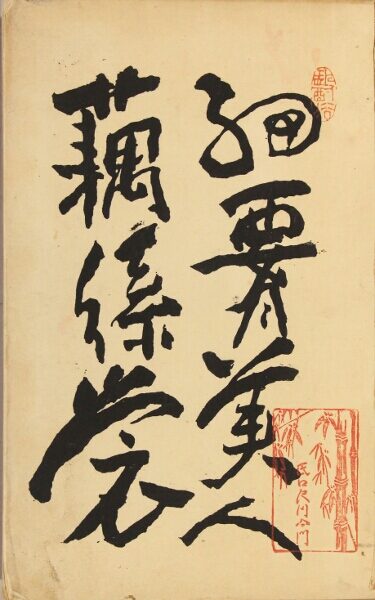
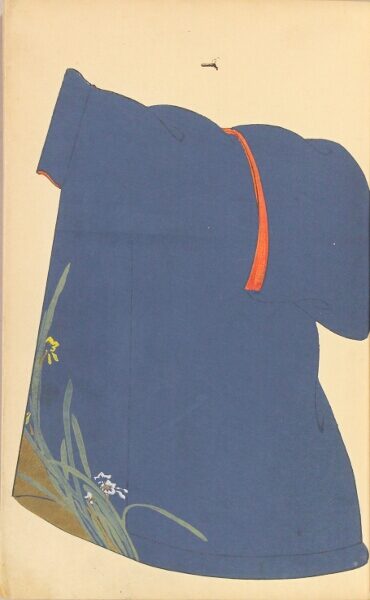

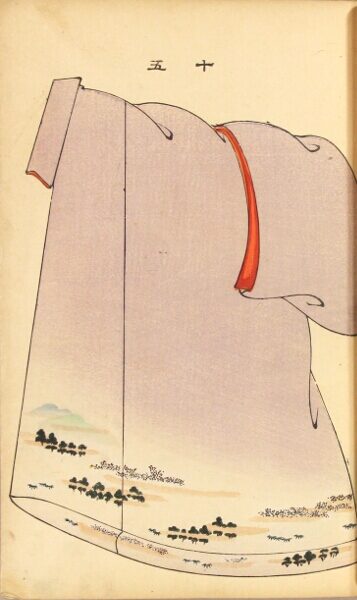
20. [Trade Catalogue.] [Haori jackets]. [Japan: Meiji 40 - not published -, ca. 1908].
$2,250
Small folio (approx. 12¼" x 8½"), containing a title leaf printed on 2 sides, and 50 leaves containing 100 fine colored woodblock prints of silk haori jackets (worn over kimonos), with detailed highlights after designs of the Nihonga artist, Tessai Tomioka (1837-1924); contemporary plain paper wrappers, stab-bound (yamatotoji) with renewed silk thread; interior clean and bright; contained in a folding brown cloth Japanese case.
Tomioka Tessai (also known as Tomioka Tetsusai) "was the pseudonym for a painter and calligrapher in imperial Japan. He is regarded as the last major artist in the Bunjinga tradition and one of the first major artists of the Nihonga style. His real name was Yusuke, which he later changed to Hyakuren" (Wikipedia). In 1907, about the same time as this trade catalogue was made, he was appointed official painter to Emperor Meiji. He was born in Kyoto in 1837, and was one of the inaugurators of the Nihonga style of painting which emphasized the traditional Japanese style which stood in contrast to the then current Yōga style which was influenced by Western traditions. Nihonga was traditionally applied to washi or silk with pigments using natural ingredients such as shells, lapis lazuli, cinnabar, or azurite, and mixed with glue.


21. Beau Brummell. New York: Rimington & Hooper, 1930.
$1,250
First edition limited to 550 copies (this, no. 325) signed by Virginia Woolf; folio, pp. [6], 8, [6]; original red cloth-backed gray paper-covered boards, pink paper label on upper cover; lacking the publisher's slipcase, otherwise a very good, sound, and clean copy.
Designed and embellished by W. A. Dwiggins, and printed and bound at the Printing House of William Edwin Rudge.
Kirkpatrick A15a.

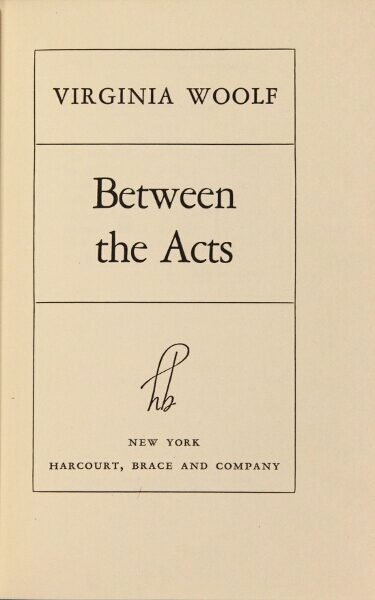
22. Between the acts. New York: Harcourt, Brace and Company, [1941].
$175
First American edition, 8vo, pp. [4], 219, [1]; fine copy in a fine, unclipped dust jacket.
Kirkpatrick A25b.

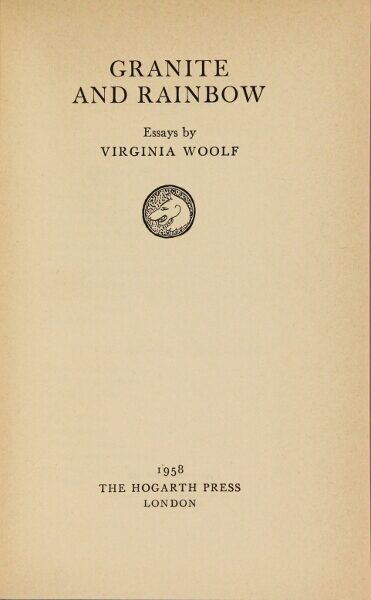
23. Granite and rainbow. Essays. London: Hogarth Press, 1958.
$500
First edition, 8vo, pp. 239, [1]; fine copy in a near fine, unclipped dust jacket designed by Vanessa Bell.
Previously forgotten, lost, or anonymously published criticism gathered by Leonard Woolf, including "The Anatomy of Fiction," "The New Biography," and one of my favorites, her assessment of Oliver Wendell Holmes.
Kirkpatrick A34a.


24. Monday or Tuesday ... With woodcuts by Vanessa Bell. Richmond: published by Leonard & Virginia Woolf at The Hogarth Press, 1921.
$3,500
First edition (only 1000 were printed); 12mo, 91, [3]; 4 full-page woodcuts, a very good to fine copy in white paper boards printed in black and designed by Vanessa Bell, brown cloth spine.
In this copy the plates are slightly offset. Tissue guards have been laid in for at least the last 40 years making the offsetting much lighter than usual.
Hand-set and printed by F. T. McDermott (with Leonard Woolf's help) at the Prompt Press, Richmond;
Kirkpatrick A5a.
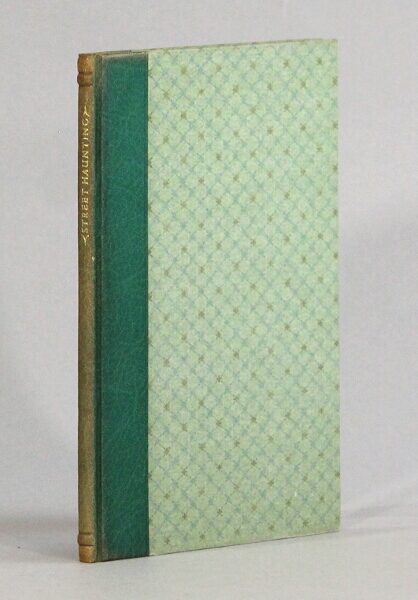
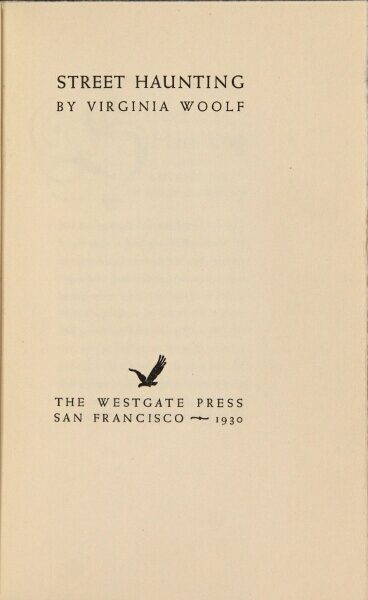

25. Street haunting. San Francisco: Westgate Press, 1930.
$4,500
Edition limited to 500 copies signed by Woolf (this, no. 314), and printed at the Grabhorn Press, small 8vo, p. [4], 35, [1]; pp., fine copy in original quarter green morocco over patterned sage green paper-covered boards; spine sunned, else near fine in publisher's green paper-covered slipcase.
Kirkpatrick notes: "There is at least one variant of the binding in sage-green paper boards patterned in gold and darker green with an emerald-green leather spine and a green slip-in case. Mr. David McGee (bibliographer of the Grabhorn Press) states: "The majority of the edition was bound in blue — a ratio of 10 to 1 in favor of blue."
Kirkpatrick A13a.


26. The common reader: second series. London: published by Leonard & Virginia Woolf at the Hogarth Press, 52 Tavistock Square, 1932.
$950
First edition, 8vo, pp. 270; text very lightly toned, else a fine copy in original green cloth stamped in gilt on upper cover and spine, in a very good, slightly chipped dust jacket, designed by Vanessa Bell, with a small streak at the top of the spine.
Kirkpatrick A19a.


27. The moment and other essays. London: Hogarth Press, 1947.
$650
First edition, 8vo, pp. 191, [1]; original maroon cloth, gilt-stamped spine, with slight bubbling off the cloth on the upper cover, and preserving an unclipped dust jacket a little sunned along the spine, and with a neat, but unprofessional repair on the verso of the bottom of the spine. The jacket is designed by Vanessa Bell.
Kirkpatrick A29a.